
Simple Harmonic Motion (2019)
Simple Harmonic Motion is an umbrella title for a number of conceptually related, but separate and distinct works.
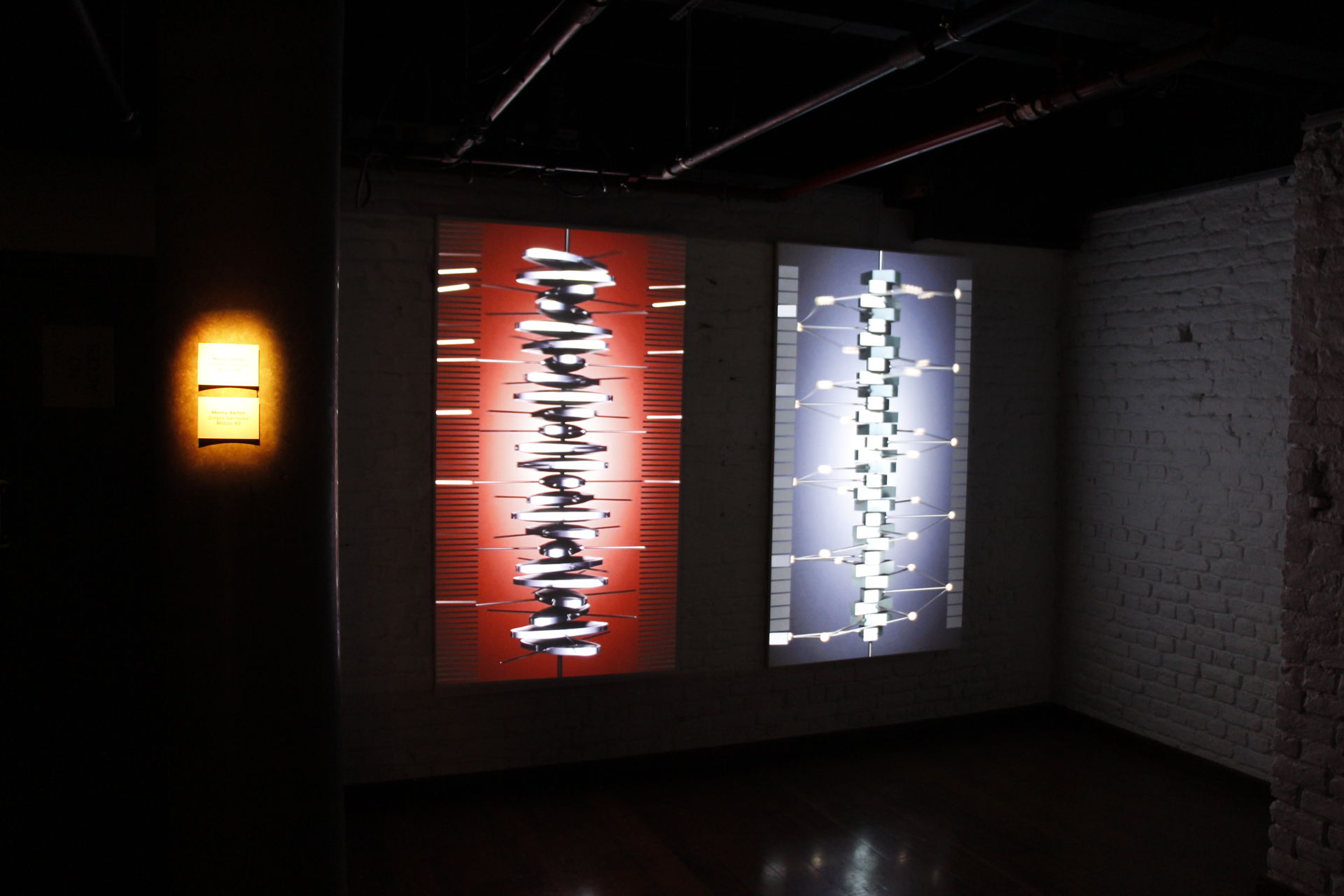
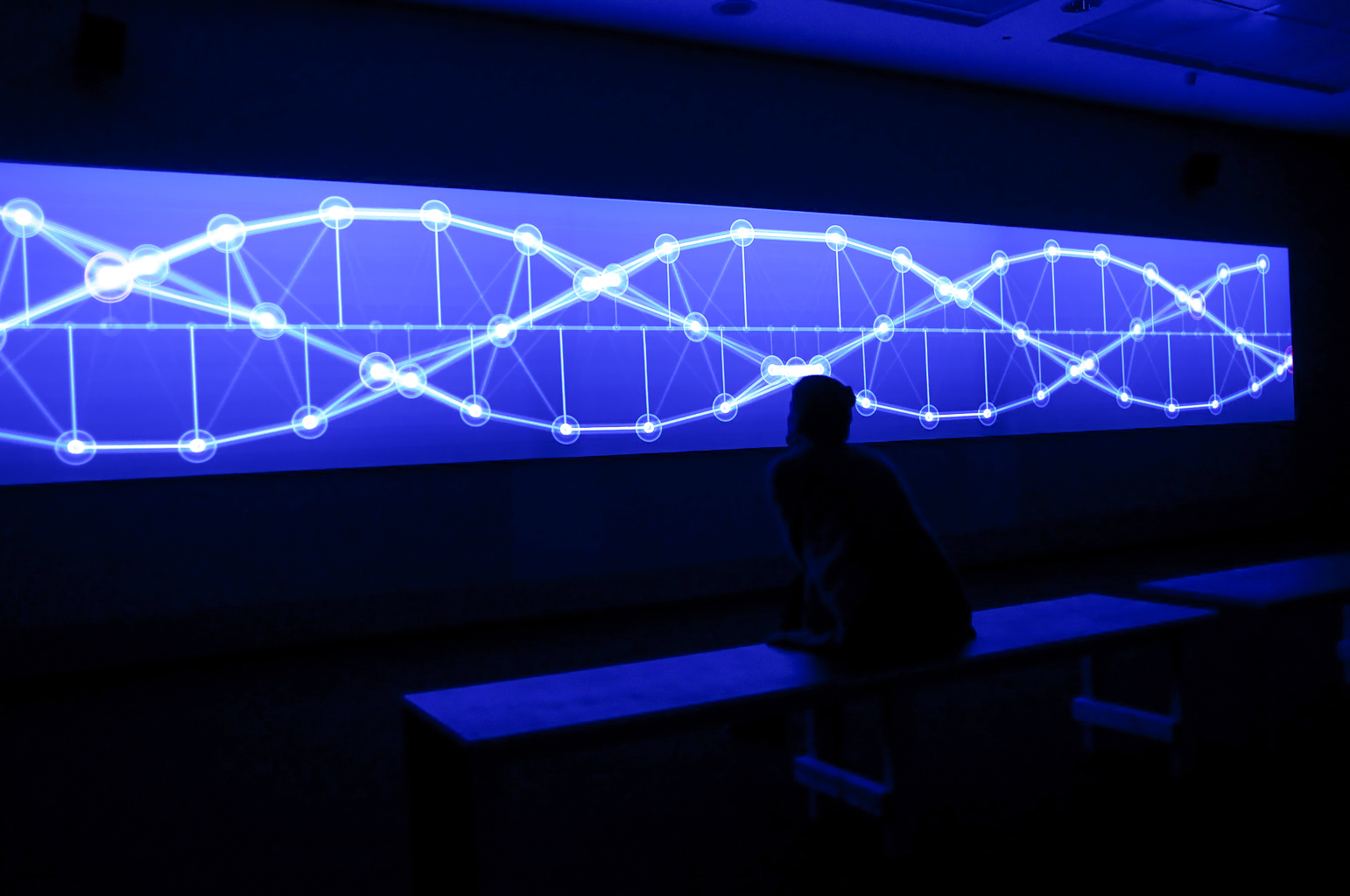
Simple Harmonic Motion (SHM) is a series of works investigating the emergence of complex behaviour through the interaction of simple patterns, invoking the delicate balance between chaos and order, and the harmonies, tensions and conflicts between science, technology, culture, ethics, tradition and religion (read more here). It is inspired by natural and mathematical phenomena, as well as works by the likes of Norman Mclaren, John Whitney, Steve Reich, John Cage, Gyorgi Ligeti and Edgar Varèse.
The Awesome Machinery of Nature: We are all connected (2021) [LINK]
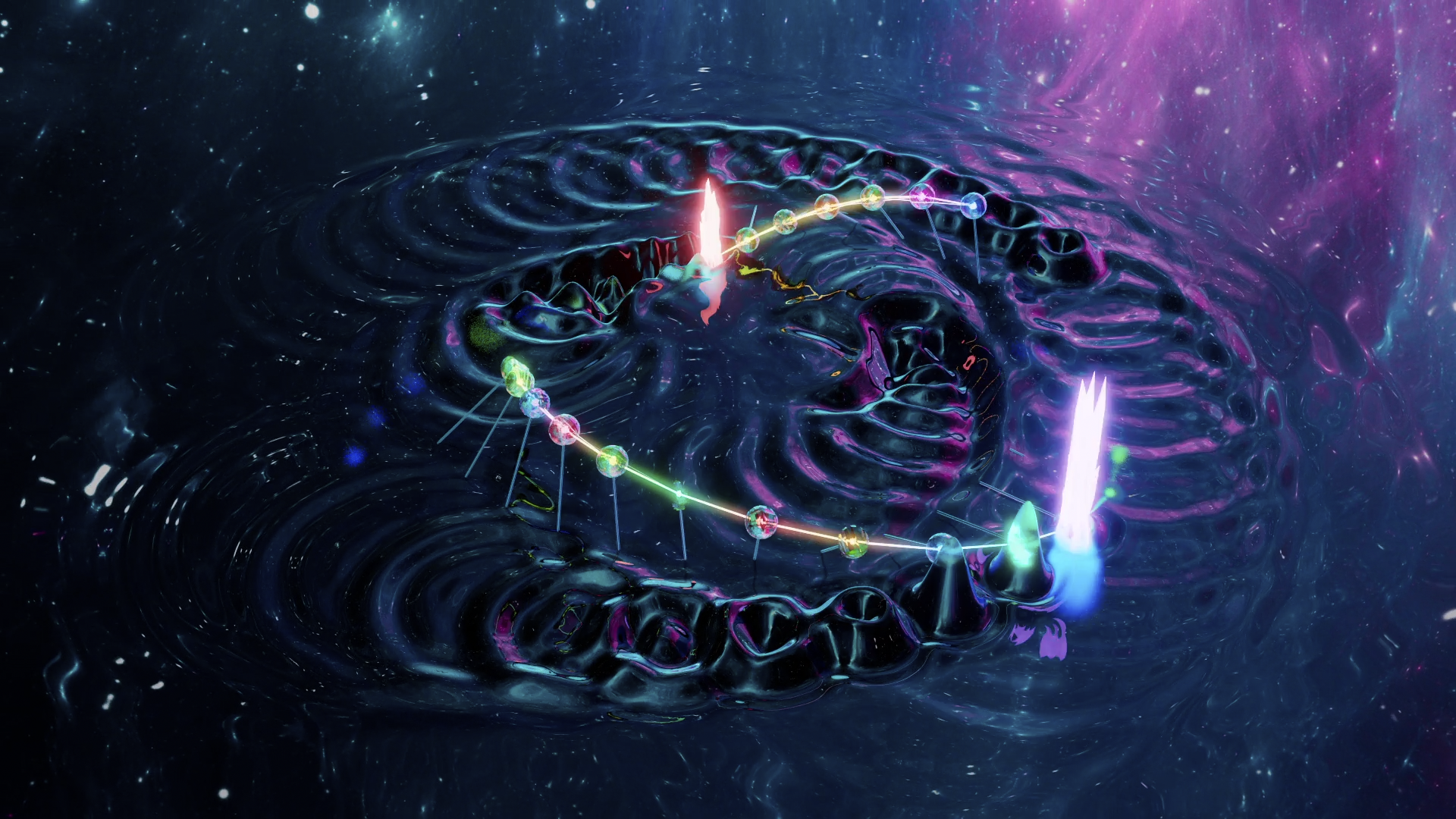
“The Awesome Machinery Of Nature: We are all connected” is an abstract film, a Speculative Simulation and Computational Composition that celebrates the interconnectedness of all living and non-living things across many scales of time and space – from the interactions of sub-atomic particles and oscillations in the quantum fields that permeate space-time; to the formation of matter and stars; to the emergence and evolution of life from inanimate matter, and the cosmic webs that connect us all.
Simple Harmonic Motion #12 for 16 Percussionists at RNCM (2015) [LINK]
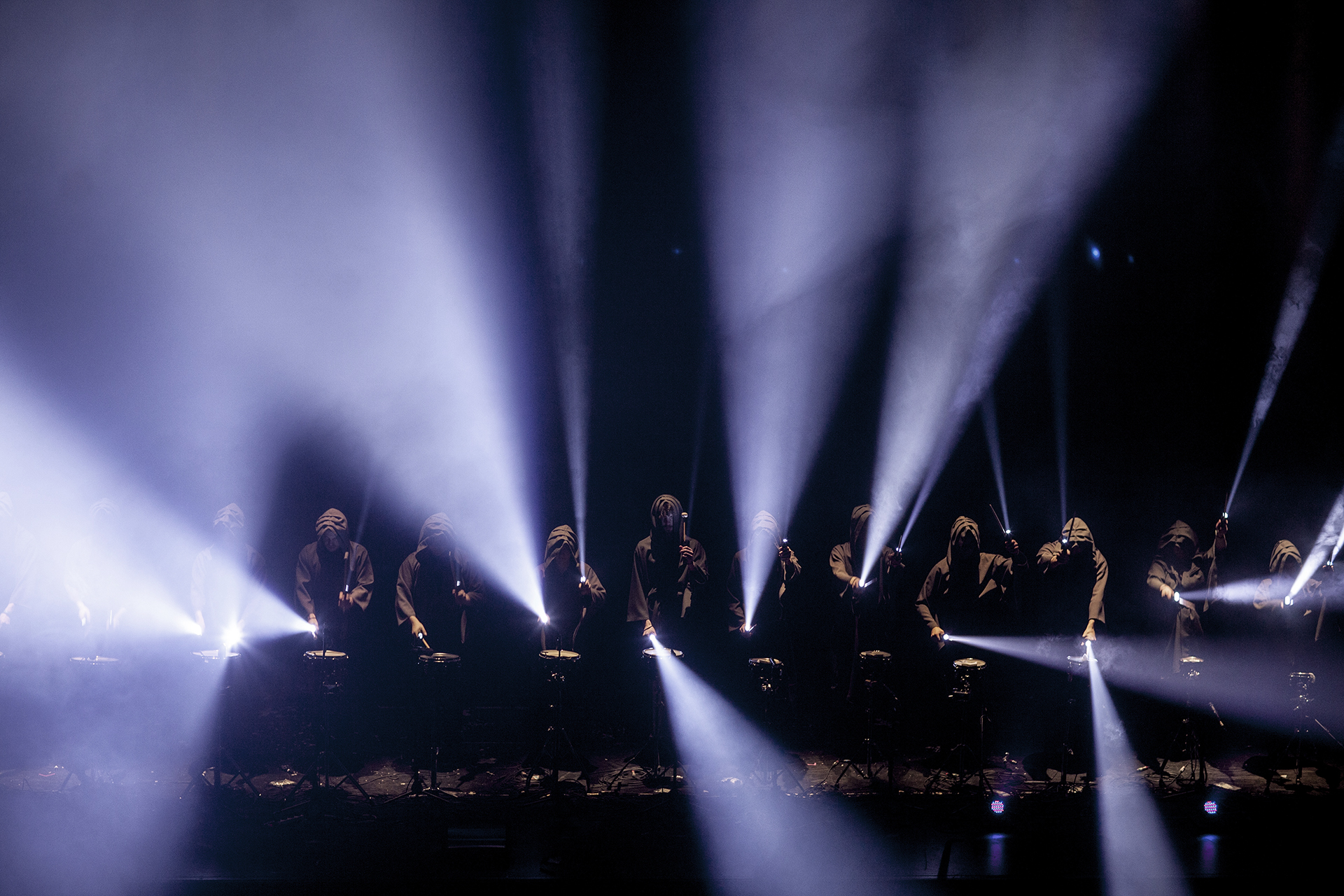
SHM #12 for 16 percussionists (2015), builds on this theme to explore the complex relations between human and machine; navigating the harmonies and tensions between science, technology, culture, ethics and tradition.
Mirroring the tensions created when new scientific knowledge and technologies disrupt existing ways of living, traditional values, and moral frameworks, the piece drifts in and out of sync, shifting between order and chaos.
Sixteen human performers are individually controlled by a central computer, running custom software, an algorithmic composition. The performers each receive unique cues via in-ear monitors — when to step forward into the light, when to raise their arms, hit their drum (triggering a sound and light pulse), turn on their flashlight, and when to step back into darkness. They are not aware of the larger composition. They simply obey their individual instructions coming from the machine. They are executing the code. And they each perform very simple, repetitive, monotonous tasks. However, collectively, they are a complex superorganism, controlled by the machine, playing out an intricate composition of sound and light.
Simple Harmonic Motion #6 Performance proof of concept (2011)
Proof of concept video (2011) for the live performance (2014).
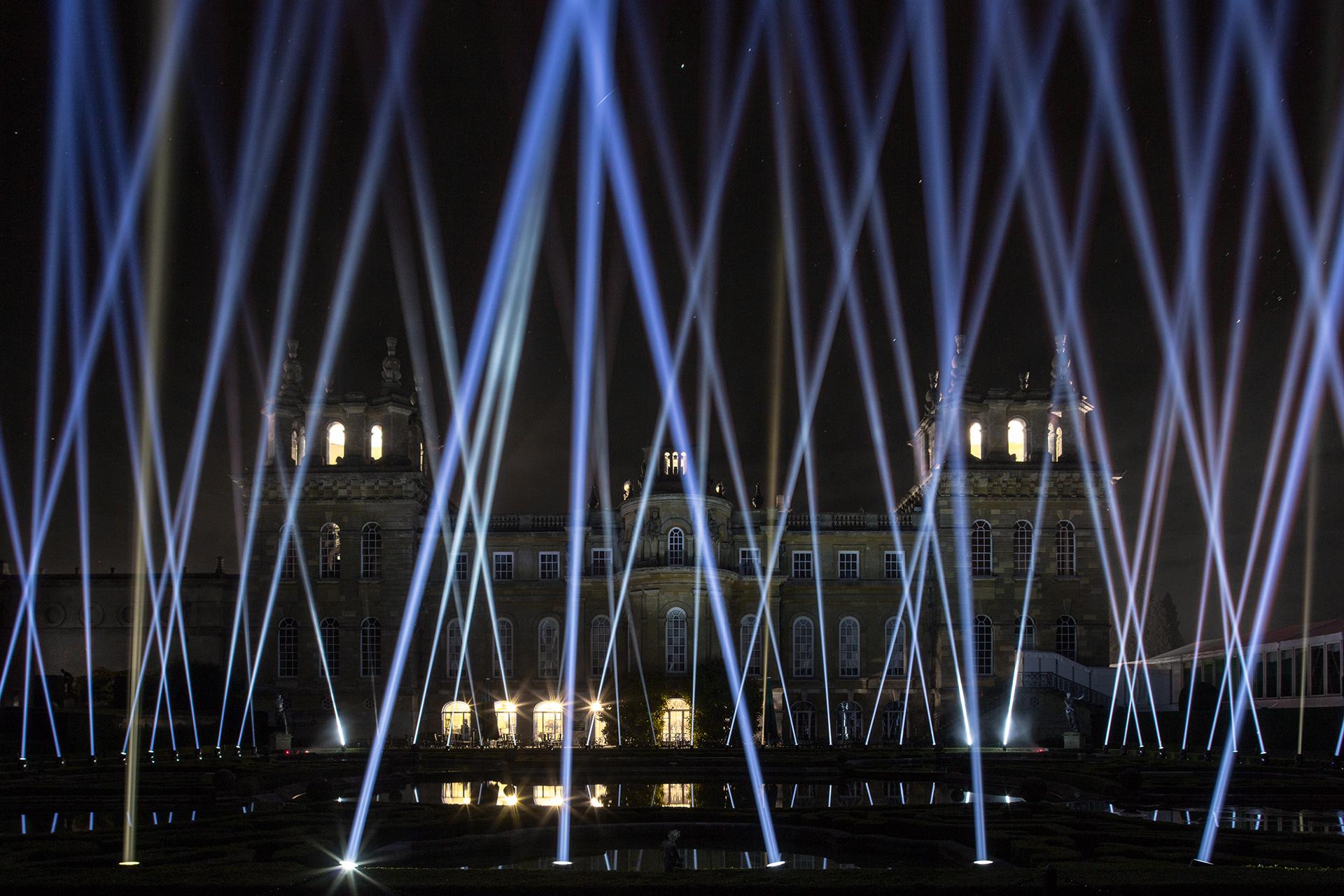
Simple Harmonic Motion #11 for Light at Blenheim Palace (2014) [LINK]
Simple Harmonic Motion #8, #9 (2013) [LINK]
Simple Harmonic Motion #5 (2011) [LINK]
Images
Simple Harmonic Motion #12 for 16 Percussionists at RNCM
Simple Harmonic Motion #11 for Light at Blenheim Palace
Simple Harmonic Motion #8, #9
Simple Harmonic Motion #5
Simple Harmonic Motion #5d, Curtain Call
More information
The initial motivation for the project is a personal abstract memoir of growing up in and experiencing Istanbul. Inspired by Orhan Veli Kanik’s poem “Istanbulu dinliyorum” (“I’m listening to Istanbul with my eyes closed”), it is a very non-literal visual and sonic interpretation of the cultural diversity of the city; a collision of cultures and intertwined opposites: progressive vs conservative, religious vs secular, liberal vs authoritarian, extreme decadence vs severely moral; interwoven, not only in the same city, but in the same streets, the same buildings. Seemingly conflicted yet managing to not only co-exist, but breeding thriving and flourishing subcultures. In the chaos of the city, a rich tapestry of different lifestyles, different patterns and rhythms cross paths on a daily basis. The intersection of these rhythms create complex cyclical, quasi-periodic patterns. Movements that may initially appear to be random and arbitrary, are actually governed by an elaborate order creating recognizable yet constantly evolving behaviour.
In the works, both images and sounds are driven by the same mathematical principles and algorithms: a complex signal, broken down into its basic elements operating at different frequencies. While this underlying fundamental principle – the fourier series – is a purely abstract mathematical theorem, it is also responsible for our understanding of almost every aspect of the physical, biological and social world; including but not limited to acoustics, economics, quantum mechanics, predicting earthquakes, protein structures, DNA and the composition of distant stars and galaxies.
The Simple Harmonic Motion series of works transposes the invisible elegance found in these abstract mathematical equations, driving almost every aspect of our lives, to a medium we can see, hear and feel.
Through the use of custom software, a number of ‘agents’ are created and assigned a simple behaviour, a repetitive pattern of movement and sound. On their own, each agent is monotonous and mechanical, acting completely unaware of their neighbours and ‘the bigger picture’. However the interaction of the different agent’s behaviours create complex, rich, evolving behaviours and compositions – both visually and sonically.
Our abilities in recognising patterns sonically are very different to our abilities in recognising patterns visually. On the whole (excluding circumstances where people are visually or sonically impaired), people tend to be more spatially sensitive with their visual perception, while they are more temporally sensitive with their aural perception. I.e. it is easier for most of us to estimate where and how far away something is by seeing it, as opposed to just hearing it. However we are sonically more temporally sensitive, both on a macro scale (e.g. it is easier for most of us to detect whether a pulse is exactly on a beat accurate to a few milliseconds by hearing a repetitive sound, compared to seeing a flashing image) and also on a micro scale (e.g. it is difficult for most of us to detect an exact doubling of frequency in light waves – i.e. hue shift; however an exact doubling of frequency in sound waves – i.e. an octave transpose – is relatively realistic for many humans to detect). By translating patterns between visual and sonic domains; and between spatial and temporal axes, we are able to recognize and realize interesting new relationships previously unnoticed.
By abstracting, emphasising and amplifying the beautiful complex patterns created from the interaction of simple harmonic motion at different frequencies, the project aims to share the enthusiasm, excitement and fascination I personally feel from such observations in nature and fundamental physical and mathematical phenomena. Ultimately hoping to encourage and inspire others to look at the world around them in more detail, with a more interrogatory approach; most importantly learning to find fascination in what they normally would not even have looked at; and even leading them to do more research along similar lines; hopefully in turn encouraging and inspiring others.
Series
VideoEcologyGalleryMusic & Sound DesignSimulationLight
InstallationSoftwareGalleryLightMusic & Sound DesignSimulation
PerformanceSoftwareLightMusic & Sound DesignSimulation
InstallationSoftwareLightMusic & Sound DesignSimulation
VideoGalleryMusic & Sound DesignLightSimulation
VideoGalleryMusic & Sound DesignLightSimulation
Selected Exhibitions, Performances & Presentations(3 / 3)
InstallationSoftwareGalleryLightMusic & Sound DesignSimulation
PerformanceSoftwareLightMusic & Sound DesignSimulation
InstallationSoftwareLightMusic & Sound DesignSimulation
Words(2 / 2)
Press(16 / 16)
Interviews(4 / 4)
Books(1 / 1)
Catalogs(1 / 1)
Other Coverage(8 / 8)
News(2 / 2)
Awards & Fellowships(1 / 1)
Commissions(2 / 2)
Collections(1 / 1)
Show History(8 / 8)
Performances(1 / 1)
Group Exhibitions(7 / 7)
Details
- Year
- 2011-ongoing
- Technique
- Custom software, generative video and music composition
- Medium
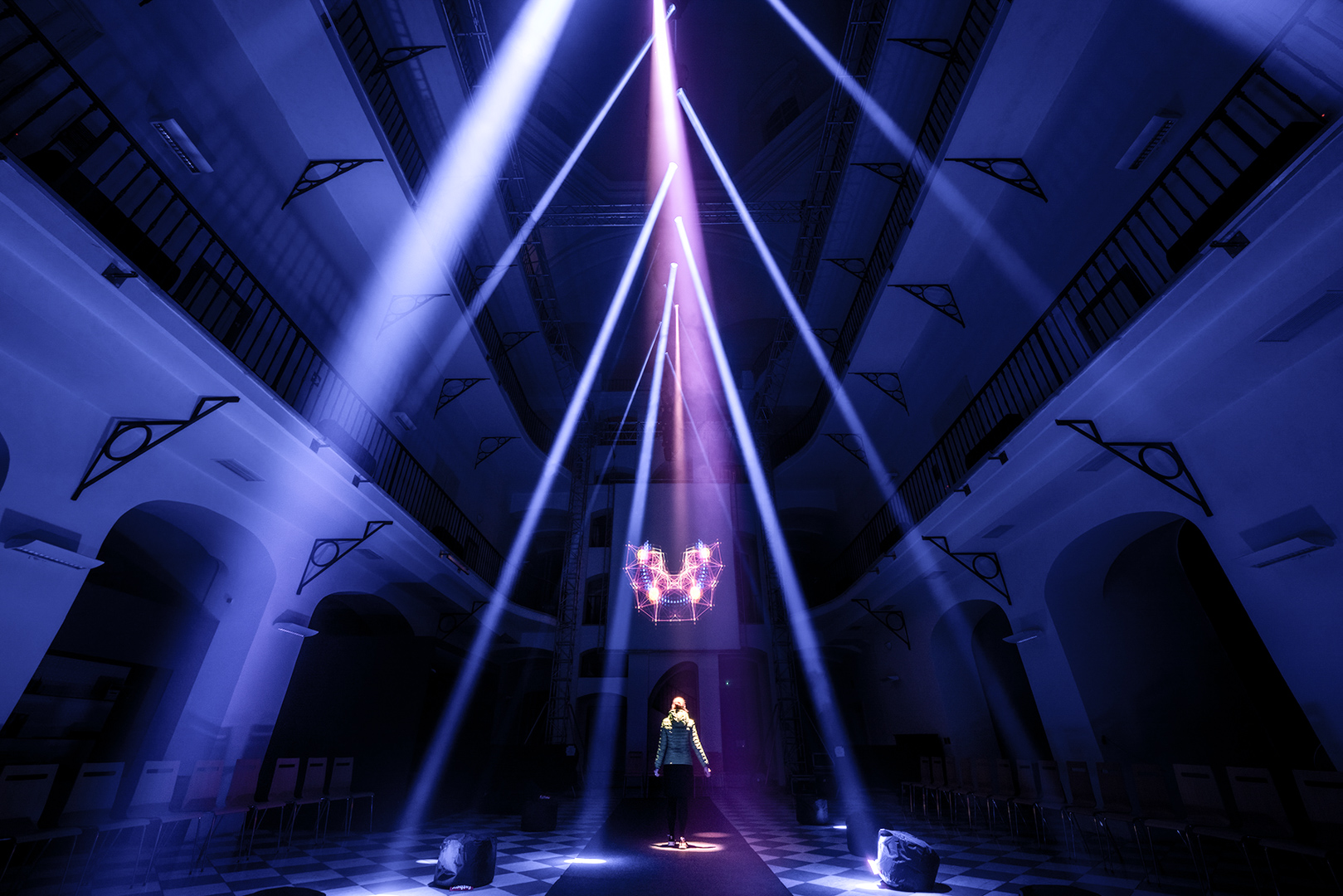
- Versions: 1. Video with audio (variable durations); 2. Kinetic light installation with robotic spotlights, multi-channel spatialized audio; 3. Live performance with 16 percussionists, handheld torches, drums, spotlights, LEDs, microphones, spatialized audio.