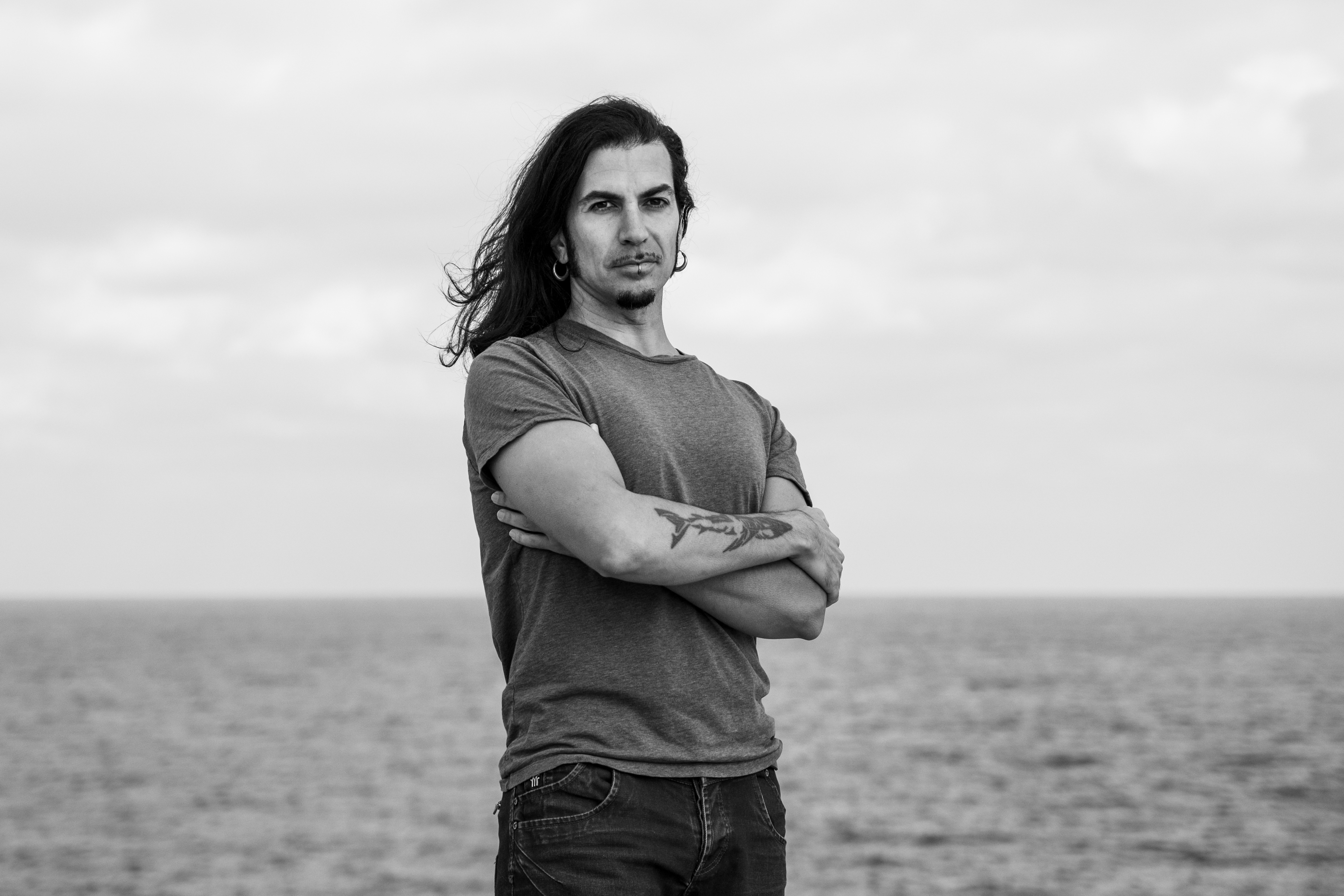
Memo Akten
Bio
b. Istanbul, TR, 1975
Short (~125 words)
Memo Akten is an artist, researcher, and computer scientist working with emerging technologies both as creative medium and as subject of critical inquiry. He creates Speculative Simulations and Data Dramatizations that probe the cultural, social and ecological impacts of our contemporary techno-lifestyles, and the collisions between science and spirituality, modernity and ritual, self and collective intelligence. His practice spans moving image, sound, language, dance, installation and performance, often employing algorithmic, data-driven, and interactive processes.
He holds a PhD in Artificial Intelligence and Computational Art from Goldsmiths, University of London, is Associate Professor at UC San Diego, and cofounder of the Superradiance Center for Entangled Intelligence and Planetary Consciousness. He has exhibited and performed internationally and received numerous awards including the Prix Ars Electronica Golden Nica.
Medium (+ ~200 words)
Major works include Body Paint (2009), exhibited in the V&A’s Decode (London, 2009) and the Academy Museum’s Color in Motion (Los Angeles, 2024–25); Forms (2012), awarded the Prix Ars Electronica Golden Nica; Learning to See (2017), exhibited in the Grand Palais’s Artistes & Robots (Paris, 2018) and the Barbican’s AI: More than Human (London, 2019), and held by M+; Deep Meditations (2018), exhibited at the Mori Art Museum and UCCA Center for Contemporary Art, and held by the Guy & Myriam Ullens Foundation; Distributed Consciousness (2021), presented as a year-long solo exhibition at ACMI (Melbourne, 2023–24); Boundaries (2024), presented in Venice during the 60th Venice Biennale and held by the Vanhaerents Art Collection; Superradiance (2024), presented at Tribeca Immersive and BFI London Film Festival, and as part of Getty PST ART; and The Thinking Ocean (2026), commissioned by the Whitney Museum of American Art for its artport collection and included in artport: A History of Internet Art (New York, 2026).
Performance-lectures are an important part of his practice, with presentations at Jacob’s Pillow, MUTEK, Sónar+D, Ars Electronica, and IDFA DocLab. He has presented his research at leading academic conferences including SIGGRAPH and NeurIPS, and his collaborative practice includes projects with U2, Depeche Mode, Lenny Kravitz, Max Cooper, and Richard Dawkins.
Extended (~850 words)
Memo Akten is an artist, researcher, and computer scientist working with emerging technologies both as creative medium and as subject of critical inquiry. He creates Speculative Simulations and Data Dramatizations that probe the cultural, social and ecological impacts of our contemporary techno-lifestyles, and the collisions between science and spirituality, modernity and ritual, self and collective intelligence. His practice spans moving image, sound, language, dance, installation and performance, often employing algorithmic, data-driven, and interactive processes.
Akten holds a PhD in Artificial Intelligence and Computational Art from Goldsmiths, University of London. He is Associate Professor at UC San Diego and cofounder of the Superradiance Center for Entangled Intelligence and Planetary Consciousness, an interdisciplinary research lab investigating how bodies, minds, and planetary systems create and shape one another, through research-based art that bridges embodied experience with emerging technologies.
Embodiment, movement and performance are central to Akten’s practice. An early interactive work, Body Paint (2009), turned the body into an expressive visual instrument and was included in the Victoria & Albert Museum’s Decode: Digital Design Sensations (London, 2009) and the Academy Museum of Motion Pictures’ Color in Motion: Chromatic Explorations of Cinema (Los Angeles, 2024–25). Forms (2012), created with Quayola and commissioned by the National Media Museum, received the Prix Ars Electronica Golden Nica in 2013. Akten has collaborated extensively with dancers and choreographers throughout his career, using movement to explore how we think, perceive and communicate through the body and probe the boundaries between self and environment. His dance collaborations include works commissioned by the Royal Opera House and Sadler’s Wells.
In 2011, Akten co-founded the experimental art, science and technology studio Marshmallow Laser Feast, which he co-directed until 2014; their work during this period won numerous awards, including a D&AD Graphite Pencil.
Akten has worked with computer vision and machine learning since the mid-2000s, initially developing immersive, responsive systems to augment human creative expression. As these technologies became embedded in everyday life, his practice expanded to critically examine the systems themselves. Keeper of our Collective Consciousness (2014), an early Big-Data-driven poetic collaboration with Google Search itself, explores intimacy and vulnerability under technological surveillance. Optimising for Beauty (2016–17) exposes bias in the mathematics of machine-learning algorithms, beyond biases in their datasets. Both works were exhibited in Ming Contemporary Art Museum’s Mind the Deep (Shanghai, 2019–20).
Against a backdrop of growing social and political polarization, Akten’s work from the mid-2010s uses AI to reflect on our own cognitive biases, the nature of perception, how we make meaning and construct our reality, and the gap between felt experience and its outward representations. Among his best-known works from this period are Learning to See (2017), exhibited in the Grand Palais’s Artistes & Robots (Paris, 2018) and the Barbican’s AI: More than Human (London, 2019), and Deep Meditations (2018), exhibited in the Mori Art Museum’s Future and the Arts: AI, Robotics, Cities, Life (Tokyo, 2019) and UCCA Center for Contemporary Art’s Immaterial/Re-material: A Brief History of Computing Art (Beijing, 2020). Works from these series are held in the collections of M+ Museum of Contemporary Visual Culture and the Guy & Myriam Ullens Foundation, respectively.
These works are also part of Akten’s Deep Visual Instruments research into large neural networks as expressive, playable media for real-time interaction, extending his earlier work with responsive environments. ULTRACHUNK (2018), created with Jennifer Walshe, is one of the earliest live performances in which both image and sound are generated entirely by neural networks in real time, responding to human performers.
Akten has presented his research at leading academic conferences including SIGGRAPH and NeurIPS; in 2021, his PhD thesis abstract was selected by Leonardo for publication.
Since the late 2010s, Akten’s work has increasingly framed intelligence, creativity, agency and authorship as distributed and relational, reckoning with the consequences of seeing ourselves as separate from the living systems that sustain and make us.
These questions underpin Distributed Consciousness (2021), presented as a year-long solo exhibition at ACMI in Melbourne from 2023–24. They also inform a series of collaborations with Katie Hofstadter, including Boundaries (2024), commissioned by the Vanhaerents Art Collection and presented in Venice during the 60th Venice Biennale; and Superradiance (2024), whose first chapter, Embodied Simulation, was an Official Selection of Tribeca Immersive and BFI London Film Festival in 2024, while its second, Embodying Earth, was part of Getty PST ART: Art & Science Collide.
The Thinking Ocean (2026), commissioned by the Whitney Museum of American Art for its artport collection and included in artport: A History of Internet Art (New York, 2026), investigates intelligence and mind at planetary scales and asks what happens when we alter or sever the relationships through which we are constituted.
Performance-lectures are an important part of his practice, with presentations at Jacob’s Pillow, MUTEK, Sónar+D, Ars Electronica, and IDFA DocLab.
Selected residencies and fellowships include Google Artists & Machine Intelligence, where Akten was the first artist-in-residence in 2016; the Hellman Fellowship; Leonardo@Djerassi; Pioneer Works and OceanX. He has served on juries for Prix Ars Electronica and SIGGRAPH, and as a jury member and mentor for Google Arts & Culture programs. His collaborative practice has included projects with U2, Depeche Mode, Lenny Kravitz, Max Cooper, and Richard Dawkins.
Decades ago, Akten started working with computation as an artistic medium to explore new modes of creative expression, continually examining developments in computational technology—including AI—as they emerged. Over the years, as these technologies evolved, so did his practice.
Today, many threads come together in his work, in response to computation and AI becoming increasingly dominant forces reshaping the world, flattening it into what can be measured, modeled, optimized and automated. But the living systems through which our bodies and minds emerge are not reducible to those abstractions. They exist far beyond the reach of machine metaphors and computational frameworks: complex assemblages of organisms, environments, cultures and planetary processes; dynamically coupled, recursively organized, with causal relations flowing upwards, downwards, sideways, in all directions at every level. A deeply entangled, beautiful mess. His practice now asks what happens when we alter or sever those relationships? What are we changing in ourselves? How can we reconnect to our planetary body and mind?
Awards & Fellowships(6 / 6)
Commissions(12 / 12)
Residencies(8 / 8)
Collections(15 / 15)
Service & Affiliations(9 / 9)
Exhibitions, Performances and Other Showings(221 / 221)
Solo Exhibitions and Presentations(9 / 9)
Performances(30 / 30)
Group Exhibitions(182 / 182)
Invited Talks, Panels and Performance-Lectures(86 / 86)
PhD Research
I’m delighted to learn that Leonardo, the prestigious peer-reviewed journal focusing on the intersections of art, science and technology, has selected my thesis abstract to be amongst their highest-rated, and to be published in their October 2022 issue (Vol 55, No 5). https://leonardo.info/labs-2021
Thesis can be downloaded from https://research.gold.ac.uk/id/eprint/30191/
This work was made primarily between 2014-2019, and published in 2021. Completed in the Department of Computing, Goldsmiths University of London; under the supervision of Dr. Mick Grierson and Dr. Rebecca Fiebrink; funded by the EPSRC.
Title
Deep Visual Instruments: Realtime Continuous, Meaningful Human Control over Deep Neural Networks for creative expression
Abstract
In this thesis, we investigate Deep Learning models as an artistic medium for new modes of performative, creative expression. We call these Deep Visual Instruments: realtime interactive generative systems that exploit and leverage the capabilities of state-of-the-art Deep Neural Networks (DNN), while allowing Meaningful Human Control, in a Realtime Continuous manner.
We characterise Meaningful Human Control in terms of intent, predictability, and accountability; and Realtime Continuous Control with regards to its capacity for performative interaction with immediate feedback, enhancing goal-less exploration. The capabilities of DNNs that we are looking to exploit and leverage in this manner, are their ability to learn hierarchical representations modelling highly complex, real-world data such as images. Thinking of DNNs as tools that extract useful information from massive amounts of Big Data, we investigate ways in which we can navigate and explore what useful information a DNN has learnt, and how we can meaningfully use such a model in the production of artistic and creative works, in a performative, expressive manner.
We present five studies that approach this from different but complementary angles. These include: a collaborative, generative sketching application using MCTS and discriminative CNNs; a system to gesturally conduct the realtime generation of text in different styles using an ensemble of LSTM RNNs; a performative tool that allows for the manipulation of hyperparameters in realtime while a Convolutional VAE trains on a live camera feed; a live video feed processing software that allows for digital puppetry and augmented drawing; and a method that allows for long-form story telling within a generative model’s latent space with meaningful control over the narrative.
We frame our research with the realtime, performative expression provided by musical instruments as a metaphor, in which we think of these systems as not used by a user, but played by a performer.
Description
This research investigates how the latest developments in Machine Learning – with an emphasis on Deep Learning – can be used to create intelligent systems that enhance artistic expression. These are systems that people can interact with and gesturally ‘conduct’ to expressively produce and manipulate text, images and sounds – in effect, collaborating with a ‘creative’, ‘talented’ agent. These systems learn – both offline and online – and have a level of autonomy that could be perceived as creative behaviour.
The desired relationship between human and machine (software) here is analogous to that between an Art Director and graphic designer, film director and video editor, concept / story teller and ghost writer – i.e. a visionary communicates their vision to a ‘doer’ who produces the actual output under the direction of the visionary (though often the doer also shapes the output with their own vision and skills). Crucially, the desired human-machine relationship here also draws inspirations from that between a pianist and piano, a conductor and orchestra, an abstract expressionist painter and the system comprising of brush + paint + canvas + gravity + fluid dynamics. I.e. again a visionary (human) communicates their vision to a system which produces the actual output, but this communication is real-time, continuous and expressive; it’s an immediate response to everything that has been produced so far, creating a closed feedback loop.
Within this very broad topic, the key problem area that the research tackles is as follows: Given a very large corpus of example data (e.g. thousands or millions of examples), we can train a generative deep model. That model will hopefully learn something, and contain some kind of ‘knowledge’ about the data (and its underlying structure). The questions are: i) What exactly has the model learned? how can we investigate what knowledge the model contains? ii) how can we do this interactively and in real-time, and expressively explore the knowledge that the model contains iii) how can we use this to steer the model to produce not just anything that resembles the training data, but what we want it to produce, when we want it to produce it, again in real-time and through expressive, continuous interaction and control.
Employment & Academic Appointments
- 2024–Current Co-founder / Co-director, Superradiance Center for Entangled Intelligence and Planetary Consciousness
- 2026–Current Associate Professor, University of California San Diego, La Jolla, CA, USA
- 2020–2026 Assistant Professor, University of California San Diego, La Jolla, CA, USA
- 2011–2014 Founder / Director, Marshmallow Laser Feast, London, UK
- 1998–2003 3D Artist, Design & Technology Manager, Deibus Studios, London, UK
Education
- 2014–2021 PhD, Artificial Intelligence & Computational Art, Goldsmiths University of London, Dept of Computing, UK.Thesis: “Deep Visual Instruments: Realtime Continuous, Meaningful Human Control over Deep Neural Networks for creative expression”
- 1993–1997 BSc, Civil Engineering, Bosphorus University, Istanbul, TR.Awarded second prize for final thesis “Automation of Reinforced Concrete Frame Structures”
- 1986–1992 High School Degree, Robert College of Istanbul, Istanbul, TR.Awarded (highest) Sait Halman Prize for “Excellence in Computer Science”
Headshots